What Is Extreme Agentic Prototyping?
At its core, Extreme Agentic Prototyping is the process of using autonomous AI agents—not just as assistants, but as co-creators—to develop software, products, or entire systems at unprecedented speed. These agents are given broad goals rather than narrow tasks, and they work together (and with humans) to explore, generate, and refine prototypes in real time.
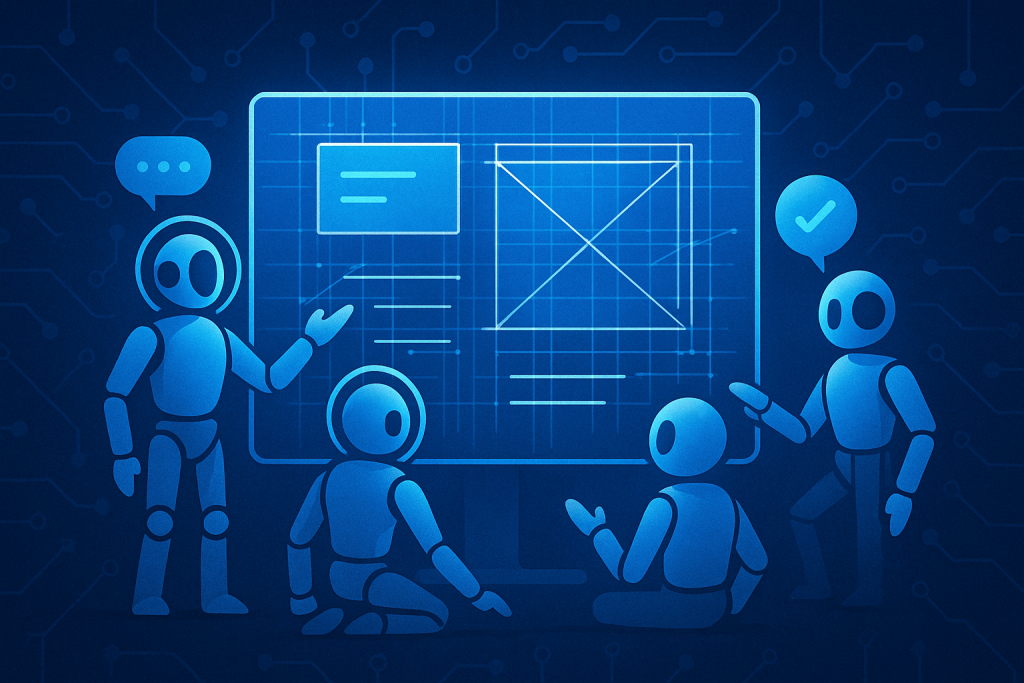
Think of it as the evolution of “rapid prototyping” but amplified by agentic intelligence — where each AI unit has initiative, memory, reasoning, and adaptability.
Instead of you manually iterating every version, your AI team iterates for you.
The Core Principles
- Agentic Autonomy
Each AI agent operates semi-independently with its own goals, roles, and skill sets — similar to how members of a real product team work. A single project may include:- A Design Agent for UI/UX concepts
- A Code Agent for backend and logic
- A Research Agent for sourcing documentation
- A Test Agent for validation and debugging
- Rapid Co-Evolution
Humans and AI don’t alternate tasks — they evolve prototypes together.
You define the vision, constraints, or style; the agents respond with dozens of plausible paths, run micro-experiments, and immediately produce improved iterations. - Multi-Context Awareness
Extreme agentic systems maintain a memory of previous choices, user feedback, and performance results, allowing the next generation of prototypes to learn from all prior failures and successes — a process similar to evolutionary design. - Continuous Deployment of Ideas
Instead of waiting for long dev cycles, prototypes are continuously released into test environments, simulated users, or synthetic datasets. This shortens validation loops from months to minutes.
Why It Matters
Traditional prototyping relies on human bandwidth — a small team limited by time, fatigue, and cognitive bias.
Extreme Agentic Prototyping turns this model upside down by allowing AI-driven iteration at machine speed, while humans focus on direction, ethics, and vision.
Some practical outcomes include:
- 100x Faster MVP Development: Concepts can be transformed into functional demos within hours.
- Lower Cognitive Load: The AI handles documentation, code scaffolding, and design mockups automatically.
- Enhanced Creativity: Humans can test bold or unconventional ideas without the usual time penalty.
- Real-Time Market Adaptation: Agents can scrape data, analyze trends, and re-prototype products to fit emerging demands instantly.
Where It’s Being Applied
Extreme Agentic Prototyping is already surfacing across different industries:
- Software Engineering: Automated code generation, integration, and testing pipelines.
- Game Design: AI-driven level generation and dynamic asset prototyping.
- UX/UI: Adaptive interfaces that redesign themselves based on behavioral analytics.
- Hardware & Robotics: Simulation-based mechanical iterations accelerated by multi-agent feedback.
- Research and Policy Design: Autonomous systems that model social or economic interventions in silico before real-world trials.
The Human-AI Partnership
While “extreme” might suggest total automation, the philosophy is deeply human-centric.
Humans remain the narrative architects — the ones who set goals, values, and context. AI agents, on the other hand, act as dynamic executors that translate these visions into tangible forms.
The magic lies not in replacing humans but in amplifying human imagination — letting ideas evolve faster than any individual or team could manage alone.
Challenges Ahead
Extreme Agentic Prototyping is powerful, but not without concerns:
- Governance and Oversight: How do we ensure agentic systems stay aligned with human intent?
- Intellectual Property: When agents collaborate autonomously, who owns the result?
- Quality Control: How do we audit and validate outputs from evolving AI networks?
- Ethical Use: Rapid AI-driven iteration could outpace regulation and ethical review.
The solutions will likely involve transparent logs, chain-of-thought provenance, and new frameworks for digital accountability.
The Road Forward
Extreme Agentic Prototyping isn’t just a methodology — it’s a movement toward co-intelligence.
It challenges the traditional boundaries between design, engineering, and creativity. The teams of the future won’t just be humans with tools, but ecosystems of self-improving agents guided by visionary thinkers.
We are entering a new creative era — where ideas prototype themselves, learn, and evolve before our eyes.
In short: Extreme Agentic Prototyping transforms imagination into iteration — and iteration into evolution.
Written by Jesse Eversole
For jesseeversole.com
Your daily source for insights on technology, digital safety, and innovation.